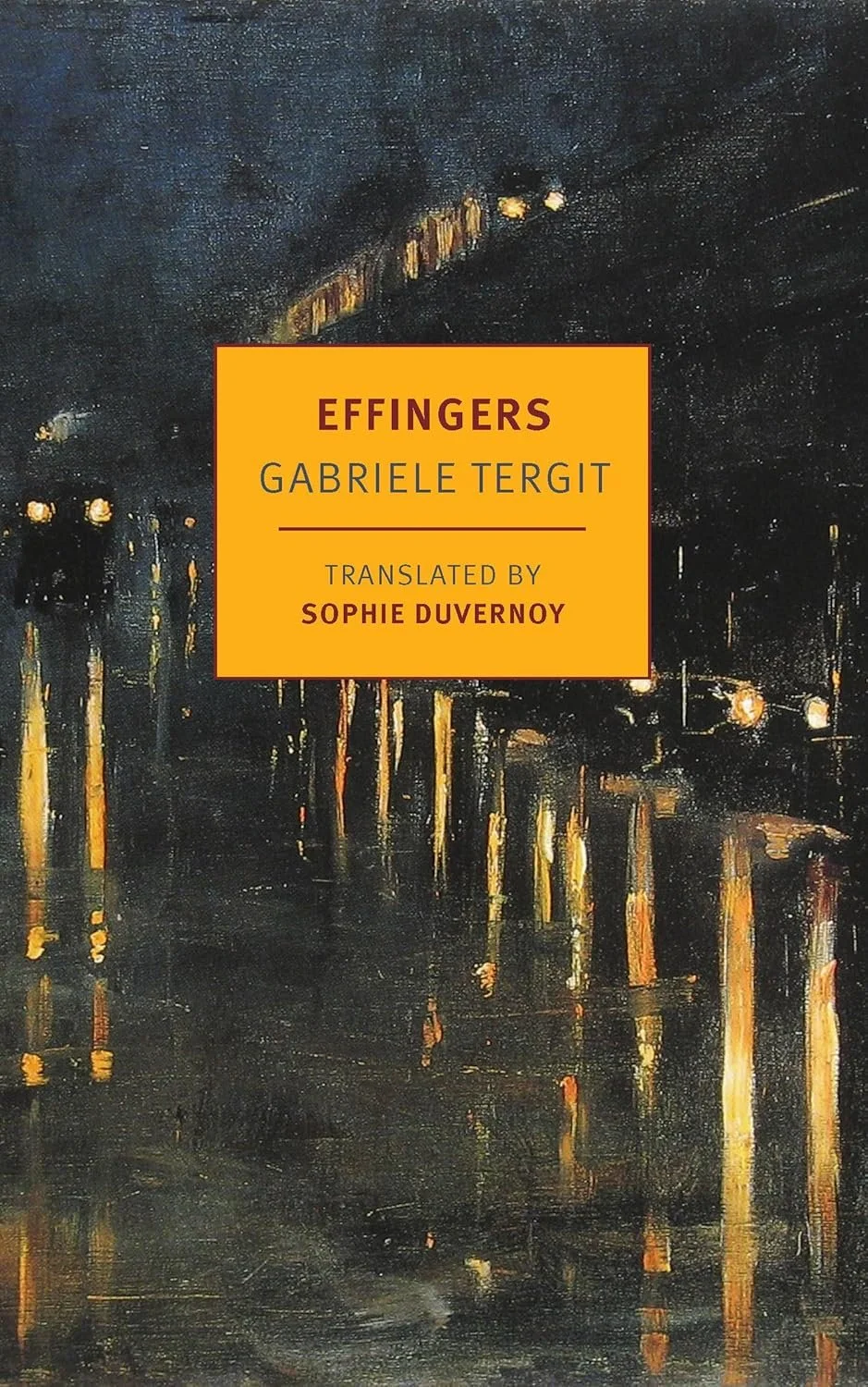
Effingers is published by New York Review Books and Pushkin Press.
Praise for Effingers:
Thomas Mann once said that if he were Jewish, Buddenbrooks would be read quite differently. Of course, if he'd been Jewish, well, who knows what kind of story he would have written? Maybe something more like Gabriele Tergit's multigenerational family saga Effingers, which, with its epic sweep, psychological depth, and linguistic brilliance, recalls Mann's novel, but which trains its sights on the heady, fraught world of the German-Jewish haute bourgeoisie. It's a remarkable book, full of insights and characters that make a lasting impression, and, happily, Sophie Duvernoy's sustained sensitivity as a writer matches Tergit's.
—Paul Reitter
Tergit’s novel, hitherto unavailable in English, is in part a roman à clef, narrated in unadorned, matter-of-fact prose. The Effinger family is a blend of urban and rural, secular and religious, socialist and capitalist . . . [each] striving to find their places in the world as the 20th century nears . . . The book, published in 1951, predated Germany’s full 'postwar reckoning with the Holocaust.' A masterwork of modern German literature.
—Kirkus Reviews, starred review
Gabriele Tergit’s Effingers is a novel, at once epic and intimate, about the lives and fates of three generations of a German Jewish family. Beginning in 1878 and ending in 1948, we follow the Effingers, a family of modest craftsmen from southern Germany, who are joined through marriage to two families of high-society financiers in Berlin, the Goldschmidts and the Oppners. The Effingers soon rise to prominence as one of the most important German industrialist families in Berlin, but with the outbreak of World War I, they fall on hard times and must navigate the tumultuous changes of the Weimar Republic.
Full of parties and drama and delicious gossip, and featuring a kaleidoscopic cast of characters, Effingers is a keenly observed account of German Jewish life in all its richness and complexity. Tergit's precise and limpid prose dazzles in Sophie Duvernoy's elegant translation.
Woefully underrated when it first appeared in 1951, and only recently rediscovered in Germany, Effingers is a meditation on identity and nationality that establishes Tergit as one of the most significant writers of the twentieth century.