Effingers is published by New York Review Books and Pushkin Press.
Now in its third printing, Effingers has received rave reviews in the New York Times, New York Review of Books, Guardian, and Wall Street Journal.
The translation was supported by a grant from the National Endowment of the Arts (2023-24) and the Berlin Senate.
Hear me discuss Effingers and its translation (in German) on Episode 6 of Krumme Straße, a podcast produced by KWI Essen and the Merkur.
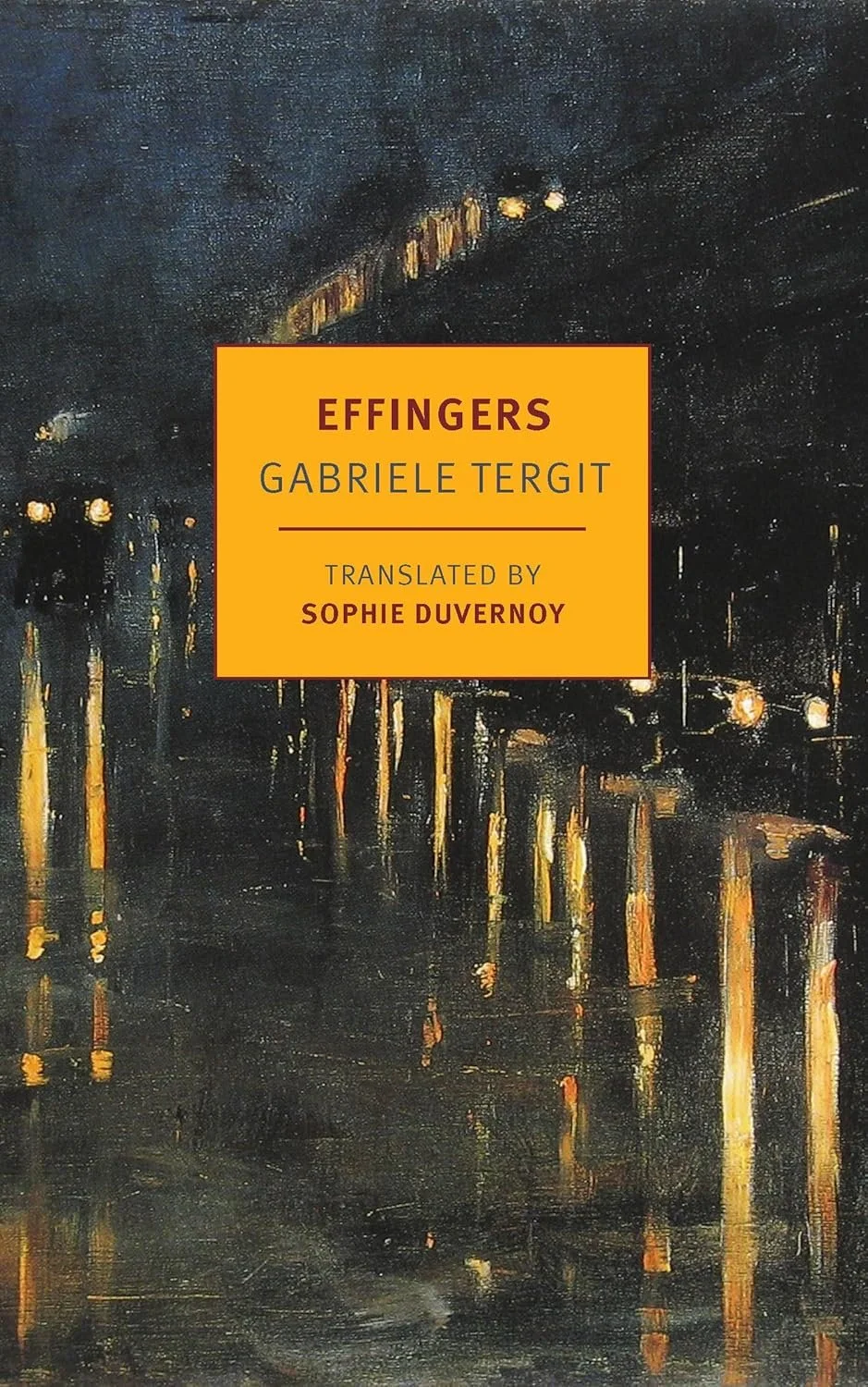
Praise for Effingers:
If any novel deserves to be called epic, it’s Effingers. Inspired by Tergit’s own family history, this account of the rise and fall of a German Jewish clan has an addictive immediacy that will make you reluctant to put it down, despite its intimidating bulk—and despite the historical storm clouds you know will be looming.
—Alida Becker, The New York Times
Duvernoy’s excellent translation of Effingers [makes] the novel accessible to American readers almost seventy-five years after its original publication. […] a lost German Jewish classic.
—Adam Kirsch, New York Review of Books
[O]nly recently has a critical rediscovery in Germany established Tergit as one of the country’s major authors. Now, thanks to an excellent translation by Sophie Duvernoy, The Effingers is appearing in English. […] The Effingers is a wonderfully vivid social portrait of pre-Nazi Berlin, whose party scenes are filled with meticulous descriptions of fashion, food, interior decor and gossip; but it is also an intellectual portrait, chiefly because its characters all think and read and argue.
—Alexander Wells, The Guardian
There are many novels about Weimar democracy’s collapse into Nazi authoritarianism. What sets “Effingers” apart is its attitude toward the destruction of German-Jewish life. Tergit refuses to present the Holocaust as the telos of a necessarily failed German-Jewish symbiosis. She never condemns European Jews for not seeing the writing on the wall. She focuses on a way of life rather than its destruction. […] In this lively and welcome translation, the barriers to this important work have come down for American readers, too.
—Dorian Stuber, Wall Street Journal
Sometimes the term ‘lost masterpiece’ proves to be little more than a publisher’s puff. At other times, however, a long-buried book that is dug up, dusted down and branded a classic is worthy of the accolade. That applies to Gabriele Tergit’s Effingers . . . It is thoroughly immersive and unfolds in precise, often stark prose, expertly translated by Sophie Duvernoy. It is packed with well drawn scenes of individual struggles and family dramas . . . The novel constitutes not only a sweeping panorama but also a series of captivating portraits.
—Malcolm Forbes, The Spectator
One of the year’s best books . […] Just as James Joyce’s Ulysses is a love letter to Dublin written in exile, so too is Effingers an ode to the [Berlin] of Tergit’s youth, in particular the grand villas of the German Jewish elite that clustered around the Tiergarten before the Second World War . . . What makes Effingers not only a serious book but a pleasurable one is Tergit’s commitment—a journalist’s—to the details that convey depths.
—A.R. Hoffman, New York Sun
[A] powerful and moving picture of a group of individuals making their way in a turbulent world. […] stunning and moving […] a major addition to the canon.”
—Martin Green, Jewish Book Council
[A] very fine translation […] The Effingers is a magnificent book.
—David Bennun, The Jewish Chronicle
Thomas Mann once said that if he were Jewish, Buddenbrooks would be read quite differently. Of course, if he'd been Jewish, well, who knows what kind of story he would have written? Maybe something more like Gabriele Tergit's multigenerational family saga Effingers, which, with its epic sweep, psychological depth, and linguistic brilliance, recalls Mann's novel, but which trains its sights on the heady, fraught world of the German-Jewish haute bourgeoisie. It's a remarkable book, full of insights and characters that make a lasting impression, and, happily, Sophie Duvernoy's sustained sensitivity as a writer matches Tergit's.
—Paul Reitter
Tergit’s novel, hitherto unavailable in English, is in part a roman à clef, narrated in unadorned, matter-of-fact prose. The Effinger family is a blend of urban and rural, secular and religious, socialist and capitalist . . . [each] striving to find their places in the world as the 20th century nears . . . The book, published in 1951, predated Germany’s full 'postwar reckoning with the Holocaust.' A masterwork of modern German literature.
—Kirkus Reviews, starred review
Gabriele Tergit’s Effingers is a novel, at once epic and intimate, about the lives and fates of three generations of a German Jewish family. Beginning in 1878 and ending in 1948, we follow the Effingers, a family of modest craftsmen from southern Germany, who are joined through marriage to two families of high-society financiers in Berlin, the Goldschmidts and the Oppners. The Effingers soon rise to prominence as one of the most important German industrialist families in Berlin, but with the outbreak of World War I, they fall on hard times and must navigate the tumultuous changes of the Weimar Republic.
Full of parties and drama and delicious gossip, and featuring a kaleidoscopic cast of characters, Effingers is a keenly observed account of German Jewish life in all its richness and complexity. Tergit's precise and limpid prose dazzles in Sophie Duvernoy's elegant translation.
Woefully underrated when it first appeared in 1951, and only recently rediscovered in Germany, Effingers is a meditation on identity and nationality that establishes Tergit as one of the most significant writers of the twentieth century.